
BIOVIT Vitamin C
Natural source: Acerola Cherry or Amla Berry

Source natural, organic Vitamin C from acerola cherry or amla berry
Two of nature's richest Vitamin C sources, supplied as organic and natural variants. Amla berry (BI081 organic, BI089 natural) at 50,000 mg/100g, and acerola cherry (BI082 organic) at 17,000 mg/100g, both with their co-occurring polyphenols intact.
Organic certified, GB and EU compliant, and a direct one-to-one replacement for synthetic ascorbic acid across beverages, supplements, gummies, and fortified foods.
Specified by leading UK manufacturers, with samples dispatched within a week and reformulation support included.

Technical Specification
Full technical data covering amla (BI081 organic, BI089 natural) and acerola (BI082 organic). For tailored documentation or a sample, get in touch with the team.
See how it works in your formulation
Samples dispatched within a week. Reformulation support included.
From carbonated beverages to gummies
Vitamin C is the most format-flexible ingredient in the BIOVIT range. Three categories where the natural sources hold strongest: drinks where ascorbic acid normally lands, gummies built around an immunity story, and live customer references already proving it works.
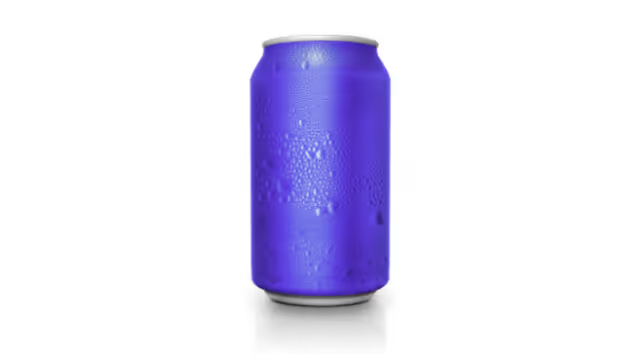
Carbonated Beverages
Compatible with carbonation and ambient processing. Water-soluble, taste-neutral, and disperses cleanly into syrups and pre-mixes without affecting carbonation hold or finish.
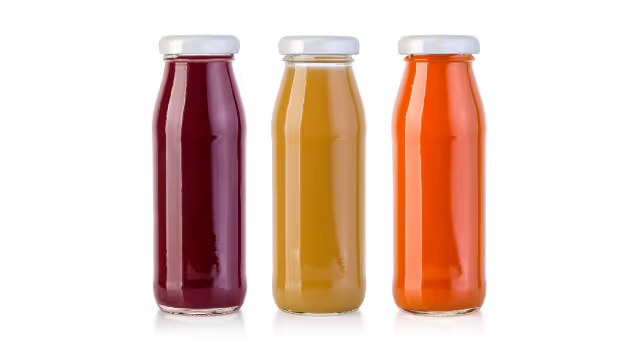
Juices & Smoothies
The cleanest possible label match. "Organic acerola cherry extract" reads as a fruit, not a fortifier, in a category where shoppers expect their Vitamin C to come from fruit in the first place.
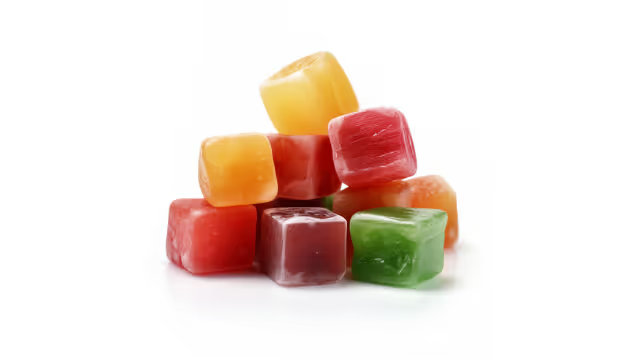
Gummies
At 0.024 g per portion (Amla), Vitamin C disappears into the gummy matrix without affecting set, texture, or finish. Pairs cleanly with Zinc and other immunity claims in multi-nutrient kids and adult gummies.
Frequently asked questions
Buyer and formulator questions on specifying acerola or amla as a natural Vitamin C source, covering bioavailability, declaration, dosage, heat stability, and EFSA coverage.
Vitamin C was one of eight micronutrients measured in BIOVIT's 30-day human intervention trial at Swansea University (61 volunteers, UKRI-funded, led by Prof Richard Bracken). The trial confirmed equivalent bioavailability between the natural and synthetic groups across the nutrients measured, supporting the position that natural Vitamin C from acerola and amla performs in line with synthetic ascorbic acid.
"Organic amla extract" for BI081, "organic acerola cherry extract, organic maltodextrin" for BI082, or "amla extract" for the natural variant BI089. All three read as recognisable fruit ingredients, which the category increasingly expects as standard.
Amla delivers the highest concentration at 50,000 mg/100g, with the smallest inclusion rate and a polyphenol-rich profile. Acerola at 17,000 mg/100g is the more familiar consumer name in beverages and gummies. The team can advise on the best match for your application.
Amla: 0.024 g per portion for "Source of", 0.048 g for "High in". Acerola: 0.071 g for "Source of", 0.141 g for "High in". For a precise cost impact in your formulation, get in touch with the team.
Vitamin C is heat-sensitive across all forms. BIOVIT's stability data from RSSL and Eurofins can inform precise overage calculations to hold label claim through pasteurisation, retort, and baking processes.
Samples and commercial orders are dispatched within around a week of order confirmation, with full technical documentation included. The MOQ is 1 kg on standard powder format. Bespoke formats and pack sizes available on request.
Yes. Every wholesale order comes with full reformulation support from BIOVIT's Head of Nutrition, Eiméar Sutton RNutr MSc. That includes equivalence mapping against your incumbent synthetic, inclusion-rate modelling, and on-pack claim wording aligned to GB and EU regulation, at no extra cost.
Vitamin C contributes to the following EU-authorised health claims under EFSA Regulation (EC) No 1924/2006:
Maintaining the normal function of the immune system during and after intense physical exercise
Normal collagen formation for the normal function of blood vessels
Normal collagen formation for the normal function of bones
Normal collagen formation for the normal function of cartilage
Normal collagen formation for the normal function of gums
Normal collagen formation for the normal function of skin
Normal collagen formation for the normal function of teeth
Normal energy-yielding metabolismNormal functioning of the nervous system
Normal psychological functionNormal function of the immune system
Protection of cells from oxidative stress
Reduction of tiredness and fatigue
Regeneration of the reduced form of vitamin EIncreases iron absorption